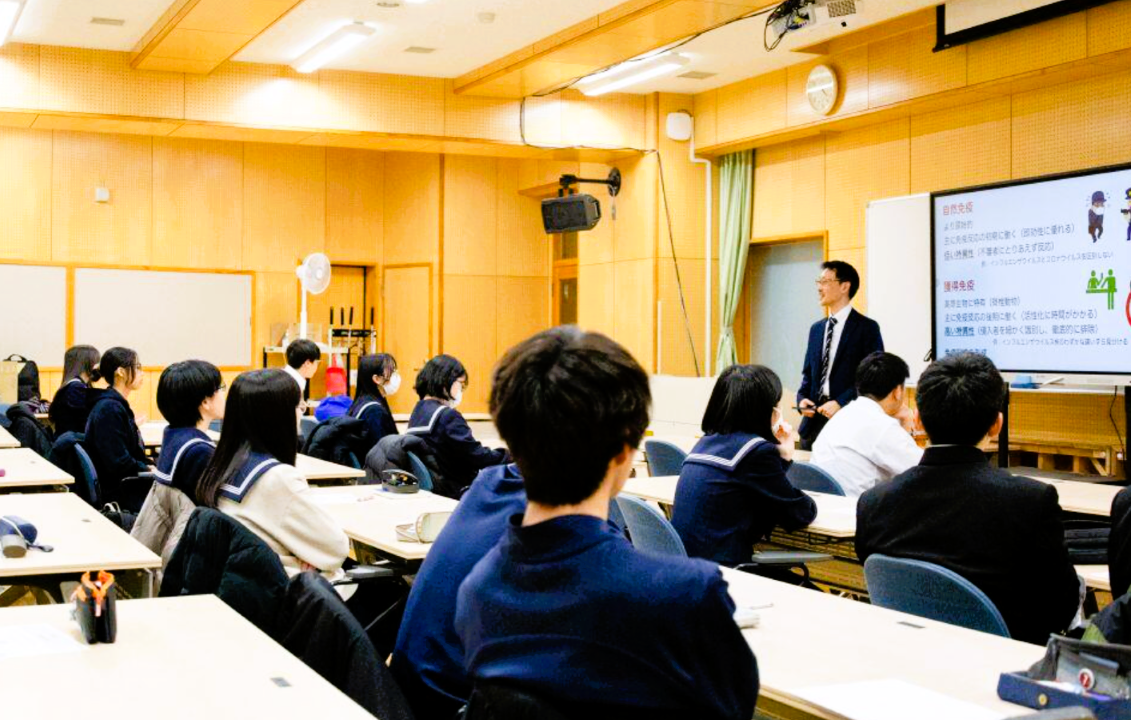
【A classroom scene highlighting student participation】
Photo provided by the Public Relations and Communications Division, Hokkaido University
On January 21, 2026, Associate Professor Keisuke Takada (Division of Vaccinology for Clinical Development) of IVReD delivered an outreach lecture titled “Why Do Vaccines Work?—How the Immune System Remembers Pathogens” at Sapporo Kita High School, attended by 32 first- and second-year students. The friendly and relaxed atmosphere enabled active participation of the students in the lecture.
The lecture was held as part of Academic Fantasista, an outreach initiative launched in 2012 under the Cabinet Office–promoted program “Dialogue between Science and Technology and Society” in collaboration with The Hokkaido Shimbun Press. Through lectures and hands-on learning experiences, the program enables researchers from Hokkaido University to share cutting-edge scientific knowledge with high school students and other young audiences.
During the session, Dr. Takada explained the basic mechanisms of the immune system that protect our bodies.
He then asked the students, “How can we tell from the data whether a vaccine works?”
Using their knowledge about immunity, the students examined the experimental results and learned the importance of thinking scientifically. The lecture showed the students that learning basic knowledge well helps them think and make decisions on their own.
In the second half of the lecture, the students were asked another question: “If we know a vaccine works, how can we explain this to people who lack knowledge on biology? “ It was a challenging topic, but the discussion gave them a good chance to think about how hard and how important it is to share scientific knowledge with others.
The students learned more about the science behind vaccines. They also learned how important it is to share research results with society and help people understand science through this lecture. These activities could spark the scientific curiosity on the students to consider STEM careers in their future. IVReD will continue to support activities that connect science and society for the next generation.